

ARC 16th International Roundtable on "Communication and Religious Humanism in the Contemporary World"
Download
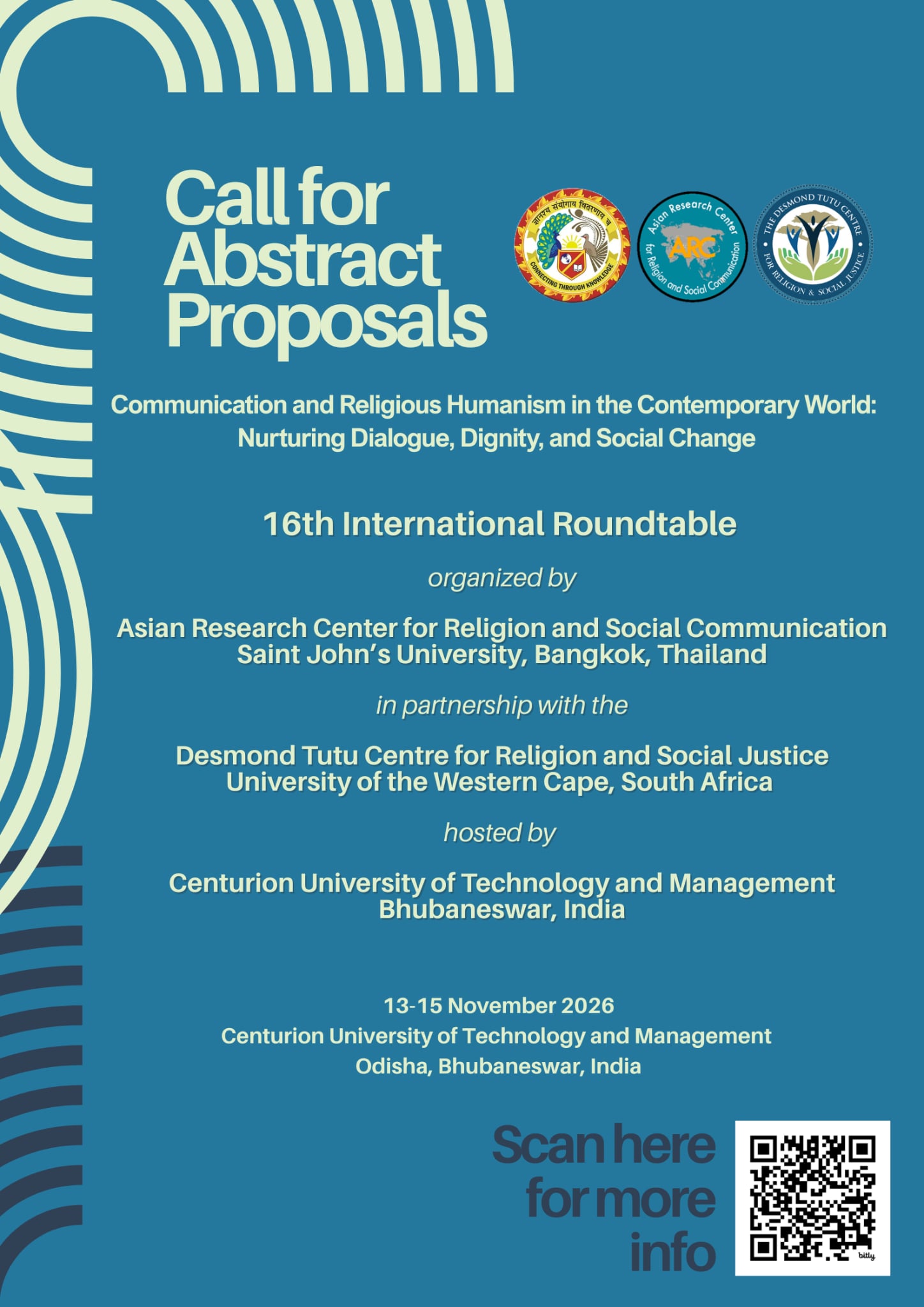
16th International Roundtable
Organized by
Asian Research Center for Religion and Social Communication, St John’s University, Thailand
In partnership with the
Desmond Tutu Centre for Religion and Social Justice, University of the Western Cape, South Africa
Hosted by
Centurion University, Bhubaneswar, India
Call for Abstract Proposals
Theme:
Communication and Religious Humanism in the Contemporary World:
Nurturing Dialogue, Dignity, and Social Change
November 13 - 15, 2026
Centurion University, Bhubaneswar, India
Introduction
Religious humanism, as a philosophical and ethical approach, affirms the dignity, agency, and moral responsibility of individuals while grounding these principles within religious epistemological and metaphysical frameworks. In seeking to harmonize faith with reason, religious humanism highlights the human capacity for compassion, justice, and ethical action across diverse cultural and religious traditions.
Across the world, the foundations of religious humanism emerge from a wide range of spiritual and philosophical heritages—including Hindu, Buddhist, Christian, Islamic, Jewish, Confucian, Indigenous, and other wisdom traditions—all of which emphasize moral transformation, social responsibility, and the intrinsic worth of the human person. These traditions, while distinctive, share converging commitments to human dignity, solidarity, and the common good.
In today’s interconnected world, however, the ideals of religious humanism are increasingly tested by intensifying socio-political conflicts, rapid digital transformations, growing inequalities, and escalating ecological crises. These global challenges demand renewed ethical reflection and dialogical engagement across religious, cultural, and ideological boundaries.
Communication—both traditional and digital—plays a crucial role in shaping religious and humanistic discourses worldwide. It can encourage dialogue, inclusivity, and social justice or, conversely, deepen polarization, misinformation, and exclusion. This international roundtable seeks to explore the theoretical and practical intersections of religious humanism and communication in addressing pressing contemporary concerns in diverse global contexts.
We invite scholars, researchers, and practitioners from a broad range of disciplines, including religious studies, cultural studies, communication, media studies, philosophy, sociology, political science, and related fields, to contribute to this important conversation. The conference aims to examine how religious humanism can offer ethical and dialogical responses to global challenges and how various forms of communication can both enable and constrain such engagements.
Conference Objectives
This conference seeks to provide a platform for scholars, researchers, and practitioners to:
- Examine the theoretical foundations and diverse expressions of religious humanism within Asian and global religious traditions.
- Analyze the role of communication, both traditional and digital, in shaping religious narratives and public discourse.
- Investigate how religious humanist principles can contribute to addressing contemporary social, ethical, and environmental challenges in the world.
- Foster interdisciplinary dialogue and collaboration to develop innovative approaches to promoting interfaith understanding and social justice.
Suggested Subthemes
Theoretical Perspectives on Religious Humanism in the World:
- Examining historical and contemporary articulations of religious humanism in Asian and global religious traditions, including their philosophical underpinnings and ethical implications.
- Exploring the relationship between religious humanism and secularism in societies.
- Analyzing the influence of traditions such as Advaita Vedanta, Buddhism, Confucianism, Christianity, Islam, or Indigenous Traditions on religious humanistic perspectives across cultures.
Religion, Media, and Public Discourse:
- Analyzing the role of traditional and digital media in shaping religious narratives, communal identities, and political ideologies.
- Investigating the impact of social media on interfaith relations, religious extremism, and dialogue across regions.
Religious Humanism and Social Justice:
- Investigating how religious humanist principles contribute to movements for caste, gender, and environmental justice.
- Examining the role of religious communities in promoting social inclusion and equality across diverse cultural contexts.
Interfaith Dialogue and Peacebuilding:
- Exploring case studies and theoretical insights on how religious humanism fosters reconciliation and social cohesion.
- Analyzing the challenges and opportunities for interfaith dialogue in the contemporary world.
Digital Communication and Religious Ethics:
- Addressing the ethical challenges and opportunities presented by digital platforms in religious and social communication.
- Examining the impact of artificial intelligence and digital technologies on religious practices and beliefs globally.
Religious Nationalism and Secularism:
- Assessing the tensions between religious humanism and contemporary political movements that engage with religious identity.
- Analyzing the impact of populism and nationalism on religious freedom and pluralism in the world.
Ecological Discourses in Religious Humanism:
- Examining how religious humanism engages with environmental ethics and sustainable development.
- Exploring connections between religious cosmologies and ecological safeguarding across different traditions.
Performing Indigeneity and Religious Identity:
- Investigating how indigenous communities navigate religious humanism in contexts of cultural assertion and political change.
- Analyzing the influence of indigenous spiritual traditions on the development of religious humanistic perspectives globally.
Submission Guidelines
We invite abstract proposals (250–300 words) that clearly articulate the research objectives, methodology, and relevance to the conference theme. Please include a brief biography (50 words) of the author(s) along with institutional affiliation and contact details.
Key Dates
Abstract Submission Deadline: May 1, 2026
Notification of Acceptance: June 1, 2026
Full Paper Submission: September 15, 2026
- For presentation only: 2,500 words
- For peer review and publication in Religion and Social Communication (ARC Journal): 6,000–8,000 words
Conference Date (In-Person Only): November 13 - 15, 2026
Please send your abstracts or inquiries to info@asianresearchcenter.org or arcstjohns.bkk@gmail.com.
We look forward to your contributions to this important conversation on religious humanism, communication, and contemporary challenges in the world.




![[RT2025]Registration Open for All Participants](https://asianresearchcenter.org/storage/image/2025/07/poster-registration-1752803792.png.160x96.webp)
![[Call for Papers]International Symposium on Religion, Media, and Culture in SEA](https://asianresearchcenter.org/storage/image/2025/07/setwidth1100-conference-february-2026-1751630356.jpg.160x96.webp)