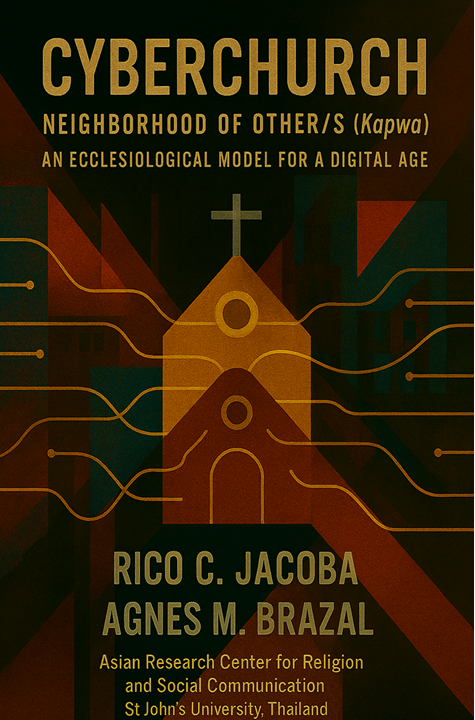

Cyberchurch – Neighborhood of Other/s (Kapwa): An Ecclesiological Model for a Digital Age
Download
Cyberchurch – Neighborhood of Other/s (Kapwa):
An Ecclesiological Model for a Digital Age
Rico C. Jacoba
Agnes M. Brazal
Published by Asian Research Center for Religion and Social Communication, St John’s University, Bangkok, Thailand
© 2025 Rico C. Jacoba and Agnes M. Brazal
This book is licensed under the Creative Commons Attribution 4.0 International License (CC BY 4.0), which permits use, sharing, adaptation, distribution, and reproduction in any medium or format, as long as you give appropriate credit to the authors.
To view a copy of this license, visit https://creativecommons.org/licenses/by/4.0/.
ISBN (ebook) 978-974-487-172-5
About the Book
The internet revolution, often likened to the Industrial Revolution in its sweeping societal impact, has radically transformed how communities gather, communicate, and express identity. In this emerging digital context, the question arises: How might we reimagine the role and mission of the Church? This book responds by proposing the Cyberchurch – Neighborhood of Others/Kapwa as a model for faith communities that inhabit and minister within cyberspace.
To explore this, the study first maps diverse online church expressions, tracing their contexts of emergence and examining their relational ties—or lack thereof—to local congregations. It then engages the themes of neighbor, other, and the Filipin@ concept of kapwa, drawing on inclusivist perspectives that honor difference and relationality. Through the application of these thematic lenses, a reinterpretation of the Good Samaritan parable is offered as a blueprint for ethical encounters in digital spheres.
Guided by Avery Dulles’s typology of church models, the book articulates the theological contours, strengths, and limitations of the Cyberchurch – Neighborhood of Others/Kapwa. This model is rooted in Scripture— particularly Matthew 18:20:“[F]or where two or three gather in my name, there am I with them”—affirming that meaningful spiritual fellowship can flourish even when physical gathering is not possible. Likewise, the parable of the Good Samaritan gains renewed relevance as a call to be good neighbors along the highways of cyberspace.
This vision of cyberchurch invites deep relational connections, ethical solidarity, and spiritual community in the digital realm. Yet it also confronts a pressing challenge: the digital divide, which risks excluding those without internet access from full participation in this evolving ecclesial form. As such, this book is both a theological reflection and a call to action—for churches, educators, and digital practitioners to build inclusive, compassionate, and justice-oriented cyber-neighborhoods where all may belong.
Praise for the Book
Jacoba and Brazal offer a compelling ecclesial exploration of the nature of digital church life, packed with methodological and theological insights that chart a pathway toward an emerging communicative theology grounded within a uniquely Asian conceptual frame. Readers will be inspired to advance theological thinking regarding cyberchurch, social communication theory, and ecclesiology in general.
The deep engagement with Filipino notions of kapwa, loob, and other indigenous Asian forms of understanding offers a rich lens for theological anthropology and ecclesiology. Scholars will appreciate the authors’ fluency in diverse literatures, which are highly fruitful for theological or social scientific work. Practitioners will discover considerable riches in the very accessible, practical, and missiological tone. No less importantly, pastoral leaders will find it an accessible and highly informative guide for ministry, whether in social communications, evangelization, or church life in general.
Bryan T. Froehle, Ph.D., Professor of Practical Theology Palm Beach Atlantic University, USA; Past President of the Association of Professors of Mission Co-author, Global Catholicism: Between Disruption and Encounter (Brill, 2025)
The digital revolution has reshaped how Christians worship, connect, and share the Gospel. The future of the Church is no longer confined to walls — it is hybrid, a living communion that moves between face-to-face and online spaces. This book dares to imagine that future. It proposes the cyberchurch as a neighborhood of others/kapwa — a Church rooted in solidarity, diversity, and radical welcome. It is not primarily an empirical study, but a theological reflection on how we might creatively envision the church in the digital age. The reflections are inspired by the Filipino context, where the word kapwa refers to the Other who is both the “one of us” and the “not-one of us.” Inspired by the parable of the Good Samaritan, it envisions communities that choose compassion over exclusion and dialogue over echo chambers.
In an original and inspiring way, the authors encourage us to look for ways in the digital world that go beyond the northern paradigms of power, domination, and competition, and to build new communities of solidarity, respect for diversity, and attention to the marginalized. This book boldly confronts the challenges of today’s digital society and seeks a new model for making the life of the church community as fruitful, creative, and fulfilling as possible. For pastors, educators, and seekers in a connected world, this is an invitation to reimagine the Church for the digital age — not as a virtual substitute for reality, but as a vibrant, ethical, and transformative communion of faith.
Roman Globokar, PhD, Associate Professor of Theology, University of Ljubljana, Slovenia; Author, Educational Challenges of Schools in the Digital Age (2019).